

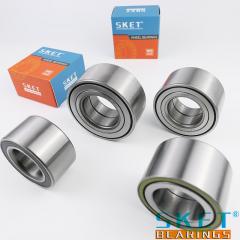
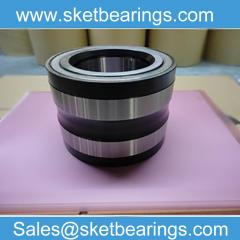
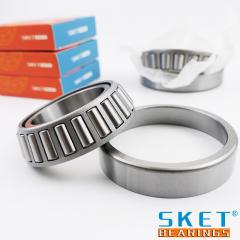
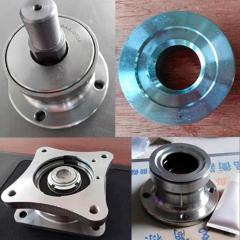
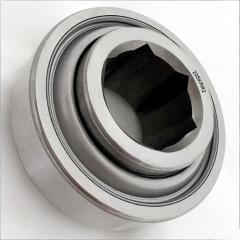

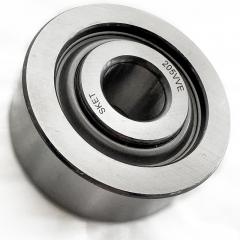

Selecting the correct tapered roller bearing requires more than simply matching the shaft diameter. Engineers, maintenance teams, and purchasing professionals must evaluate bearing dimensions, load capacity, contact angle, installation configuration, operating conditions, and replacement compatibility before making a final decision.
A reliable tapered roller bearing size chart helps users quickly compare bearing models by checking important specifications, including bore diameter, outside diameter, bearing width, dynamic load rating, and static load rating.
This taper roller bearing dimensions chart and selection guide provides practical information about common metric tapered roller bearing sizes, bearing number identification, contact angle selection, matched pair installation, and replacement considerations.
Whether you are sourcing bearings for OEM equipment, industrial machinery, agricultural applications, or aftermarket replacement, proper bearing selection can reduce downtime, improve equipment reliability, and optimize long-term operating costs.
Tapered Roller Bearing Size Chart (Metric Dimensions)
The following tapered roller bearing size chart includes commonly used metric tapered roller bearing models from 300 series designs.
| Bearing Model | Bore d (mm) | Outside Diameter D (mm) | Width T (mm) | Dynamic Load C (kN) | Static Load C0 (kN) | Weight (kg) |
|---|---|---|---|---|---|---|
| 30203 | 17 | 40 | 13.25 | 22.9 | 22.8 | 0.08 |
| 30204 | 20 | 47 | 15.25 | 28.1 | 28.5 | 0.12 |
| 30205 | 25 | 52 | 16.25 | 34.5 | 35.0 | 0.15 |
| 30206 | 30 | 62 | 17.25 | 43.5 | 44.5 | 0.23 |
| 30207 | 35 | 72 | 18.25 | 54.0 | 55.0 | 0.33 |
| 30208 | 40 | 80 | 19.75 | 63.0 | 67.0 | 0.42 |
| 30209 | 45 | 85 | 20.75 | 71.5 | 78.0 | 0.48 |
| 30210 | 50 | 90 | 21.75 | 81.5 | 92.0 | 0.55 |
| 30305 | 25 | 62 | 18.25 | 48.0 | 50.0 | 0.25 |
| 30306 | 30 | 72 | 20.75 | 60.5 | 64.0 | 0.38 |
| 30307 | 35 | 80 | 22.75 | 73.0 | 78.0 | 0.50 |
| 30308 | 40 | 90 | 25.25 | 88.0 | 98.0 | 0.70 |
| 31308 | 40 | 90 | 25.25 | 91.0 | 105.0 | 0.75 |
| 31310 | 50 | 110 | 29.25 | 126.0 | 150.0 | 1.10 |
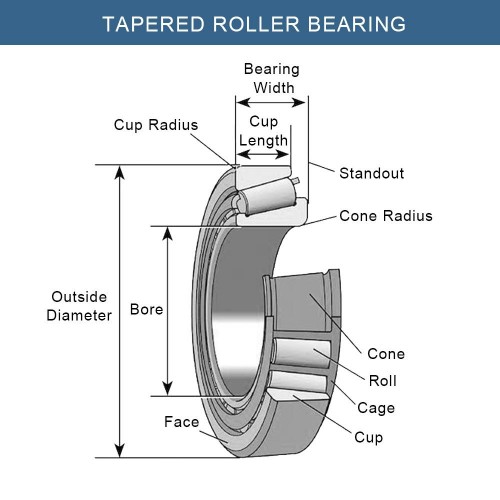
For example:
-
30205 tapered roller bearing dimensions
- Bore diameter: 25 mm
- Outside diameter: 52 mm
- Width: 16.25 mm
-
30206 tapered roller bearing size
- Bore diameter: 30 mm
- Outside diameter: 62 mm
- Width: 17.25 mm
-
30306 tapered roller bearing dimensions
- Bore diameter: 30 mm
- Outside diameter: 72 mm
- Width: 20.75 mm
Note: Bearing dimensions and load ratings may vary depending on manufacturer design, material specifications, internal clearance, and precision grade. Always verify final specifications before replacement.
Taper Roller Bearing Dimensions Chart Explained
A taper roller bearing dimensions chart normally includes several key parameters that determine bearing compatibility and performance.
Bore Diameter (d)
The bore diameter represents the inner diameter of the bearing.
It determines:
- Shaft compatibility
- Mounting fit
- Installation accuracy
For example:
A 30206 tapered roller bearing has a 30 mm bore diameter.
Incorrect bore selection may result in:
- Poor fitting
- Excessive vibration
- Reduced bearing life
Outside Diameter (D)
The outside diameter defines the required housing space.
Before selecting a replacement bearing, engineers should confirm:
- Housing bore size
- Installation clearance
- Mounting position
Bearing Width (T)
The bearing width affects:
- Load capacity
- Axial positioning
- Installation space
A wider bearing generally provides higher load capacity but requires additional axial installation space.
Dynamic and Static Load Ratings
Dynamic Load Rating (C)
Dynamic load rating indicates the bearing's ability to support rotating loads.
It is mainly used for calculating bearing life under continuous operation.
Static Load Rating (C0)
Static load rating is important when bearings experience:
- Shock loads
- Heavy impact loads
- Low-speed operation
How to Identify Tapered Roller Bearing Numbers
Understanding bearing designation helps engineers quickly identify bearing dimensions.
Example:
30206 Tapered Roller Bearing
The designation includes:
30
Bearing series code.
It identifies the bearing design characteristics.
206
Bore designation.
For standard metric tapered roller bearings:
The last two digits × 5 represent the bore diameter.
Example:
06 × 5 = 30 mm
Therefore:
30206 = 30 mm bore tapered roller bearing
Common examples:
| Bearing Model | Bore Diameter |
|---|---|
| 30205 | 25 mm |
| 30206 | 30 mm |
| 30306 | 30 mm |
| 30308 | 40 mm |
Common Tapered Roller Bearing Series
302 Series
The 302 series is one of the most widely used tapered roller bearing series.
Characteristics:
- Compact structure
- Smaller contact angle
- Good radial load capability
- Suitable for general applications
Common applications:
- Gearboxes
- Pumps
- Industrial machinery
- Agricultural equipment
303 Series
The 303 series provides higher load capacity compared with the 302 series.
Characteristics:
- Medium contact angle
- Balanced radial and axial load performance
- Larger roller design
Applications:
- Trucks
- Construction machinery
- Transmission systems
313 Series
The 313 series is designed for applications requiring higher axial load capacity.
Characteristics:
- Larger contact angle
- Higher thrust load capability
- Increased stiffness
Applications:
- Heavy machinery
- Mining equipment
- Industrial gear systems
Contact Angle and Load Capacity Selection
The contact angle is one of the most important factors affecting tapered roller bearing performance.
The contact angle determines how the bearing distributes radial and axial loads.
Smaller Contact Angle
A smaller contact angle provides:
- Higher radial load capability
- Better suitability for applications where radial forces dominate
Typical example:
302 Series
Common applications:
- Gear systems
- General industrial equipment
Larger Contact Angle
A larger contact angle provides:
- Higher axial (thrust) load capability
- Better resistance against heavy thrust forces
Typical example:
313 Series
Common applications:
- Heavy-duty machinery
- High axial load applications
Contact Angle Comparison
| Series | Contact Angle | Main Load Advantage |
|---|---|---|
| 302 Series | Smaller angle | Higher radial load capability |
| 303 Series | Medium angle | Balanced radial and axial performance |
| 313 Series | Larger angle | Higher axial load capability |
Selecting the wrong contact angle may result in:
- Excessive heat generation
- Reduced bearing life
- Poor load distribution
Tapered Roller Bearing Matched Pair Selection and Preload Adjustment
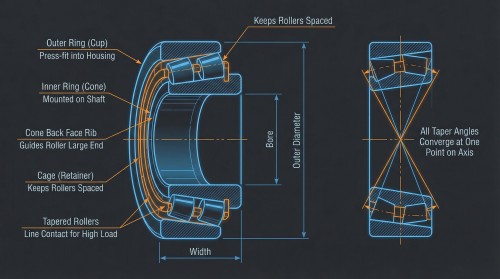
Unlike many deep groove ball bearings, tapered roller bearings are often installed as matched pairs to support combined loads and improve operating stability.
A single tapered roller bearing can support radial loads and axial loads in one direction. When equipment experiences axial forces in both directions, paired installation is usually required.
Back-to-Back Arrangement (DB)
In a DB arrangement, the wider ends of two bearings face outward.
Advantages:
- Higher rigidity
- Better resistance to overturning moments
- Improved shaft support
Typical applications:
- Gearboxes
- Machine tools
- Precision transmission systems
Face-to-Face Arrangement (DF)
In a DF arrangement, the narrower ends face outward.
Advantages:
- Better tolerance to shaft misalignment
- Suitable for applications with alignment variation
Typical applications:
- Industrial machinery
- Agricultural equipment
Tandem Arrangement
Tandem installation places two bearings in the same direction.
Advantages:
- Increased axial load capacity in one direction
Applications:
- Heavy-duty equipment
- High thrust load systems
Preload Adjustment Considerations
Proper preload adjustment is critical for tapered roller bearing performance.
Correct preload helps achieve:
- Higher stiffness
- Reduced vibration
- Improved operating accuracy
- Longer service life
Excessive preload may cause:
- Increased friction
- Higher operating temperature
- Accelerated wear
Insufficient preload may cause:
- Excessive internal clearance
- Vibration
- Reduced positioning accuracy
Preload should always be adjusted according to:
- Manufacturer recommendations
- Application requirements
- Operating conditions
Tapered Roller Bearing Selection Guide
Before selecting a tapered roller bearing, engineers should evaluate the following factors:
1. Confirm Bearing Dimensions
Check:
✓ Shaft diameter
✓ Housing dimensions
✓ Bearing width
✓ Installation space
2. Evaluate Load Requirements
Consider:
Radial Load
Generated by:
- Equipment weight
- Gear forces
- Belt tension
Axial Load
Generated by:
- Thrust forces
- Helical gears
- Machine operation
3. Consider Operating Speed and Lubrication
Operating speed affects:
- Bearing temperature
- Lubrication requirements
- Service life
For higher-speed applications, evaluate:
- Lubricant type
- Operating temperature
- Bearing clearance
Proper lubrication reduces friction and improves reliability.
4. Evaluate Application Environment
Agricultural Machinery
Applications:
- Tractors
- Disc harrows
- Harvesting equipment
Operating conditions:
- Dust
- Moisture
- Vibration
- Shock loads
Important requirements:
- Reliable sealing
- Grease retention
- Contamination protection
Industrial Equipment
Applications:
- Gear reducers
- Conveyors
- Machine tools
Requirements:
- Stable performance
- Long operating life
- Consistent quality
Automotive Applications
Common uses:
- Wheel hubs
- Transmission systems
- Differential assemblies
Requirements:
- High reliability
- Accurate preload control
- Long service life
Tapered Roller Bearing Selection Checklist
Before ordering, confirm:
☑ Bearing model number
☑ Shaft and housing dimensions
☑ Radial load requirement
☑ Axial load requirement
☑ Contact angle suitability
☑ Single bearing or matched pair configuration
☑ Operating speed
☑ Lubrication method
☑ Temperature condition
☑ Contamination environment
Common Tapered Roller Bearing Selection Mistakes
Selecting Only by Bore Size
Bearing selection should not rely only on shaft diameter.
Always verify:
- Outside diameter
- Width
- Load rating
- Contact angle
Ignoring Axial Loads
Tapered roller bearings support both radial and axial loads.
Ignoring axial forces may lead to:
- Raceway damage
- Roller wear
- Reduced service life
Incorrect Pairing
Mixing unmatched cups and cones may affect:
- Internal clearance
- Contact conditions
- Bearing performance
Always use properly matched components.
Tapered Roller Bearing Replacement and Supply Support
When replacing an existing tapered roller bearing, engineers should compare:
- Bearing dimensions
- Load ratings
- OEM reference numbers
- Operating conditions
A professional bearing supplier can provide:
✓ Dimension verification
✓ OEM replacement matching
✓ Technical selection support
✓ Bulk supply solutions
✓ Export packaging support
For distributors, OEM manufacturers, and maintenance teams, reliable supply capability and technical support are essential for reducing purchasing risks.