



Key Insights
- Insulated bearings are designed to prevent electrical damage caused by shaft voltage and bearing current in electric motor applications.
- The main difference between an insulated bearing vs standard bearing is electrical isolation capability, not basic mechanical load performance.
- Insulated bearings for VFD motors are commonly used in inverter-driven systems where high-frequency electrical currents can damage conventional bearings.
- Selecting the correct bearing requires considering motor type, electrical environment, bearing load, speed, and insulation performance.
Introduction
Electric motor bearing failures are not always caused by excessive load, poor lubrication, or incorrect installation. In modern motor systems, electrical current passing through the bearing has become an important cause of premature failure.
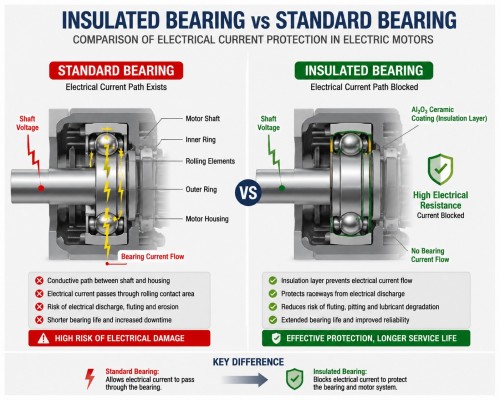
The key difference between an insulated bearing vs standard bearing is that an insulated bearing prevents harmful electrical current from passing through the rolling contact area.
Standard bearings are suitable for many conventional applications. However, insulated bearings for electric motors are often required in VFD motors, generators, and high-power drive systems where shaft voltage and bearing current can create electrical erosion.
This guide explains how insulated bearings protect motor systems, why standard bearings fail under electrical stress, and how to select the right insulated bearing for motor applications.
Insulated Bearing vs Standard Bearing: Quick Comparison
The main purpose of an insulated bearing is to prevent electrical damage while maintaining normal bearing performance.
A standard steel bearing provides a conductive path between the motor shaft and housing. When shaft voltage occurs, electrical current can discharge through the bearing and damage the raceway surface.
| Parameter | Insulated Bearing | Standard Bearing |
|---|---|---|
| Electrical insulation | Al2O3 ceramic coating or ceramic rolling elements | No electrical insulation structure |
| Bearing current protection | Blocks current flow through rolling contact area | Allows electrical current path |
| Main applications | VFD motors, generators, industrial drive systems | General mechanical equipment |
| Electrical damage risk | Reduced risk of electrical fluting and erosion | Higher risk under electrical stress |
| Typical protection method | Ceramic coating or hybrid ceramic structure | No electrical protection |
For electric motor applications, selecting a bearing only according to load rating is not sufficient. A standard bearing may meet mechanical requirements but still fail prematurely when exposed to shaft current.
For applications requiring specialized bearing designs, manufacturers should evaluate both electrical protection and mechanical performance to ensure long-term reliability.
How Shaft Currents Damage Standard Motor Bearings in VFD Systems
One of the main reasons insulated bearings for VFD motors are required is the electrical stress created by inverter-driven systems.
Variable frequency drives (VFDs) improve motor efficiency and speed control, but high-frequency switching can generate common-mode voltage and shaft voltage inside the motor system.
When the voltage exceeds the resistance of the lubricant film, electrical current discharges through the bearing.
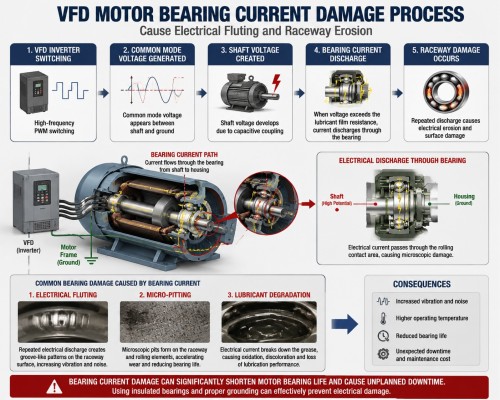
| Failure Process | Result |
|---|---|
| VFD switching generates shaft voltage | Electrical potential difference appears between shaft and housing |
| Bearing current passes through contact area | Electrical discharge damages raceway surfaces |
| Repeated discharge occurs | Fluting, micro-pitting, and lubrication degradation develop |
| Bearing surface damage increases | Vibration, noise, and premature failure occur |
Electrical Fluting
Electrical fluting is one of the most common signs of bearing current damage.
Repeated electrical discharge creates groove-like patterns on the raceway surface, increasing vibration and reducing bearing service life.
Micro-Pitting
Electrical discharge can create microscopic pits on raceways and rolling elements.
These surface defects increase friction, accelerate wear, and reduce the reliability of motor bearing systems.
Grease Degradation
Bearing current can also damage lubricant performance by accelerating grease oxidation.
As lubrication quality decreases, operating temperature increases and mechanical wear becomes faster.
Why Insulated Bearings Prevent Electrical Damage
The purpose of motor bearing insulation is to interrupt the electrical path before current reaches the rolling contact area.
By using ceramic insulation or ceramic rolling elements, insulated bearings protect the raceway, rolling elements, and lubricant from electrical erosion.
This is why insulated bearings for electric motors are commonly selected for VFD systems, generators, and industrial motors where electrical reliability is critical.
Insulated Bearing Types: Ceramic Coating vs Hybrid Ceramic
Different insulated bearings use different insulation structures. The correct design depends on motor type, operating speed, load conditions, and electrical requirements.
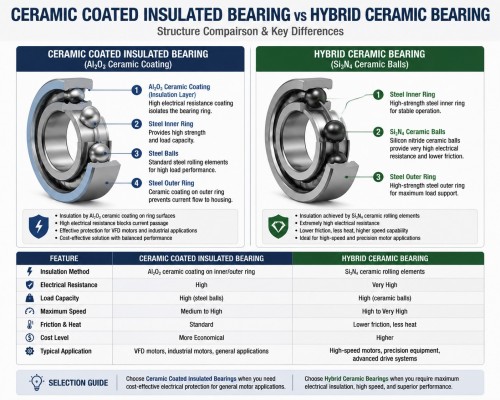
The two main insulation solutions used in electric motor applications are ceramic-coated insulated bearings and hybrid ceramic bearings.
Ceramic-Coated Insulated Bearings
Ceramic-coated bearings are widely used as insulated bearings for electric motors because they provide effective electrical isolation while maintaining conventional bearing structures.
In this design, an aluminum oxide (Al2O3) ceramic coating is applied to the bearing ring surface to create high electrical resistance between the bearing and motor housing.
Common coating designs include:
- Outer ring coated bearings: Used to isolate the bearing from the conductive motor housing.
- Inner ring coated bearings: Used to block current between the shaft and bearing inner ring.
When selecting ceramic-coated insulated bearings, buyers should evaluate:
| Performance Factor | Importance |
|---|---|
| Insulation resistance | Determines the ability to block electrical current flow |
| Coating thickness | Affects electrical protection capability and dimensional stability |
| Coating adhesion | Ensures long-term performance under vibration and temperature changes |
A properly manufactured ceramic-coated bearing maintains insulation performance while meeting requirements for bearing accuracy, speed, and load capacity.
Hybrid Ceramic Bearings
Hybrid ceramic bearings use ceramic rolling elements, typically silicon nitride (Si3N4) balls, combined with steel bearing rings.
Unlike ceramic-coated bearings, electrical insulation is achieved through the high electrical resistance of ceramic rolling elements.
Hybrid ceramic bearings provide advantages including:
- Higher electrical resistance
- Lower friction
- Reduced heat generation
- Improved performance at high rotational speeds
They are commonly selected for:
- High-speed electric motors
- Precision equipment
- Advanced drive systems
- Applications requiring maximum electrical isolation
Ceramic-Coated Bearing vs Hybrid Ceramic Bearing
| Factor | Ceramic-Coated Insulated Bearing | Hybrid Ceramic Bearing |
|---|---|---|
| Insulation method | Al2O3 ceramic coating on bearing rings | Si3N4 ceramic rolling elements |
| Electrical resistance | High | Very high |
| Cost level | More economical | Higher |
| Typical application | Industrial motors and VFD systems | High-speed and precision applications |
| Main advantage | Balanced electrical protection and cost | Maximum electrical resistance capability |
For most industrial motor applications, ceramic-coated insulated bearings provide a practical balance between electrical protection and cost. Hybrid ceramic bearings are preferred when speed, precision, or extreme electrical isolation requirements are more important.
How to Select the Right Insulated Bearing for Your Motor
Selecting an insulated bearing for motor applications requires matching electrical protection with mechanical operating conditions.
Motor Application Requirements
| Application | Recommended Bearing Solution |
|---|---|
| VFD motor | Ceramic-coated insulated bearing |
| High-power industrial motor | Insulated roller bearing |
| Generator system | Ceramic-coated or hybrid ceramic bearing |
| High-speed motor | Hybrid ceramic bearing |
For insulated bearings for VFD motors, buyers should consider inverter characteristics, motor power, operating speed, and expected service life rather than selecting a bearing only by size.
Bearing Type and Load Conditions
Electrical protection does not replace mechanical bearing selection. The bearing must still match the required load, speed, temperature, and service life.
| Bearing Type | Typical Application |
|---|---|
| Insulated deep groove ball bearing | Small and medium motors, high-speed applications |
| Insulated cylindrical roller bearing | Large motors and higher radial load applications |
| Hybrid ceramic bearing | High-speed and precision motor systems |
Buyer Verification Checklist Before Purchasing Insulated Bearings
When purchasing insulated bearings for electric motors, buyers should verify technical specifications rather than compare suppliers only by price.
Insulation Performance
Important specifications include:
- Insulation resistance
- Dielectric strength
- Coating consistency
These parameters determine whether the bearing can effectively block shaft current during operation.
Ceramic Coating Quality
For ceramic-coated insulated bearings, buyers should evaluate:
- Al2O3 coating structure
- Coating adhesion strength
- Thickness consistency
Poor coating quality may reduce insulation reliability and shorten service life in demanding motor applications.
Application Matching
A suitable insulated bearing in motor applications should be selected according to:
- Motor type
- VFD operating conditions
- Bearing load requirements
- Speed requirements
The correct bearing solution should address both electrical risks and mechanical operating conditions.
Frequently Asked Questions About Insulated Bearings
Do all electric motors need insulated bearings?
No. Not every electric motor requires an insulated bearing.
Standard bearings can perform well in applications without significant shaft voltage or bearing current risks. However, VFD motors, generators, and high-power drive systems often require additional electrical protection.
What is the difference between ceramic bearings and insulated bearings?
A ceramic bearing usually refers to a bearing containing ceramic components, such as Si3N4 ceramic balls.
An insulated bearing specifically refers to a bearing designed to prevent electrical current flow. Ceramic-coated bearings use an insulating coating layer, while hybrid ceramic bearings use ceramic rolling elements to achieve electrical resistance.
When should standard bearings be replaced with insulated bearings?
Standard bearings should be replaced with insulated bearings when electrical damage risks exist, including:
- Electrical fluting on raceways
- Repeated motor bearing failures
- VFD motor operation
- Generator applications
Selecting an insulated bearing before electrical damage occurs can reduce unexpected downtime and improve motor reliability.
Conclusion
The choice between an insulated bearing vs standard bearing depends on the electrical environment and operating conditions of the motor system.
Standard bearings remain suitable for many conventional mechanical applications. However, motors exposed to shaft voltage, bearing current, and inverter-generated electrical stress require additional protection.
For insulated bearings for electric motors, the correct selection should consider:
- Motor type
- VFD operating conditions
- Bearing load requirements
- Insulation technology
- Application requirements
Choosing the right insulated bearing solution helps reduce electrical erosion, improve motor reliability, and extend equipment service intervals in demanding industrial applications.