



You have 50 trucks in your fleet. Last quarter, three went down for wheel-end repairs. Each cost you a day of downtime, a tow truck, and a repair bill north of $1,200. The bearings were barely 18 months old.
This guide is written for procurement professionals and fleet managers who need to connect field symptoms to supplier performance. You will find:
- What each symptom actually means for your maintenance budget
- When to repair, when to replace, and when to switch suppliers
- How to spec bearings that survive your actual operating conditions
-
How different truck platforms (Volvo FH, Scania, Mercedes Actros, Trailer axle systems, Steering axle assemblies) influence bearing failure behavior
1. Noise Increase Under Load
What you will hear: Low-frequency hum on straight highways. Growl that gets louder with speed. Noise that shifts when you turn the wheel.
What it costs you now: At this stage, you have a window. The bearing is still functional. You can schedule inspection and plan replacement. If you ignore it, you will be looking at a roadside breakdown within 2,000 to 5,000 miles.
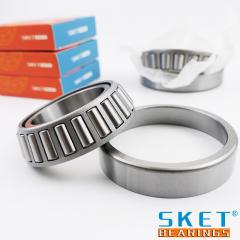
Why it happens: Raceway fatigue, lubrication breakdown, or contamination starting to score the rolling elements. In truck wheel ends, this is often traced to the tapered roller bearing set losing its surface integrity under repeated load cycles.
Tapered roller bearings for truck wheel ends →
For a detailed explanation of how contamination enters and accelerates this process, read How Dust and Mud Enter Bearings and How to Prevent It.
2. Hub Overheating
What you will see: One hub runs significantly hotter than the others. You can feel it with a temp gun or sometimes just by putting your hand near the wheel after a long run. Grease may appear dark, thin, or smell burnt.
What it costs you now: Every 10°C above normal operating temperature cuts grease life in half. At 90°C+, you are looking at bearing failure inside 500 hours. This is not a component issue—it is a specification mismatch.
Why it happens: Incorrect preload, failed seal, or grease that was never rated for your duty cycle. Overheating is a procurement problem dressed as a maintenance issue.

Fleet sensitivity note: Volvo FH long-haul tractors typically show heat-related degradation earlier under sustained highway loads, while Mercedes Actros mixed-duty fleets experience heat spikes due to frequent stop-start braking cycles.
Automotive bearings rated for stable thermal performance →
For a technical comparison of seal designs and their effect on heat management, see Comparing Seal Structures in Heavy-Duty Bearings.
3. Steering Vibration and Highway Instability
What you will feel: Truck wanders at highway speed. Steering feels loose or vague. Brake pedal pulsates unevenly. Tire wear shows cupping or feathering on one side.
What it costs you now: You are burning fuel. Rolling resistance increases by 5 to 8% when wheel-end alignment drifts. On a fleet of 50 trucks, that is roughly $15,000 per year in extra fuel—before you even replace the bearing.
Why it happens: Radial clearance has exceeded tolerance. The bearing is no longer holding the wheel hub in a fixed position relative to the axle. This is a system-level failure, not a single component problem.
Scania R-Series fleets often exhibit this symptom earlier due to high torque variability under regional haul conditions, especially in steering axle configurations.
Heavy-duty bearings for commercial vehicle platforms →
For a case study on high-speed instability and bearing clearance, see Why Standard Bearings Fail in High-Speed Tillage.
4. Seal Leakage and Contamination
What you will see: Grease weeping past the seal. Dirt or mud caked around the seal lip. Water droplets in the grease when you repack.
What it costs you now: More than 80% of wheel bearing failures are contamination-driven, not fatigue-driven. Replacing bearings without fixing the seal strategy means you will do the same job again in half the expected service life.
Why it happens: Seal lip wears out, dust and water get in, grease breaks down. In truck fleets, this often traces back to seal material not matched to road salt, winter slush, or gravel dust.

Trailer axle systems (BPW / SAF-type configurations) are especially vulnerable due to continuous road spray exposure and long-duration contamination cycles.
Sealed bearings designed for contamination-heavy environments →
For a field-tested guide to evaluating bearing quality before purchase, read How to Identify Low-Quality Bearings Before Importing.
5. Excessive Wheel Play
What you will see: Physical movement at the wheel rim when you jack up the axle and push/pull at 12 and 6 o'clock. Movement may be noticeable even before you use a dial gauge.
What it costs you now: At this stage, repair is not economic. You are replacing the bearing, the seal, and likely the hub or spindle. This is a full wheel-end rebuild: parts, labor, and downtime.
Why it happens: Raceway deformation, cage damage, or complete loss of preload. The bearing has lost its internal geometry.
Steering axle systems show this failure mode earlier than drive axles due to higher sensitivity to radial clearance deviation.
Wheel bearing replacement parts →
Preload loss almost always traces back to installation errors. Read 6 Common Bearing Installation Errors That Cause Premature Failure.
6. ABS Sensor Faults
What you will see: ABS warning light on the dash. Intermittent wheel speed signal dropouts. Fault codes pointing to sensor gap or tone ring issues.
What it costs you now: This is a modern fleet issue. Every hour a truck spends in the shop for sensor diagnostics is an hour it is not earning revenue. And if the bearing wear is bad enough to trigger sensor faults, you are already close to structural failure.
Why it happens: Bearing wear increases hub eccentricity, changing the gap between the sensor and the tone ring. Contamination can also interfere with magnetic encoding.
Mercedes Actros fleets with integrated braking systems often detect this failure earlier due to tighter sensor tolerance thresholds.
Wheel hub bearing systems with integrated sensor compatibility →
7. Procurement Decision Matrix
Use this table when your maintenance team brings you a wheel-end failure report:
What you see
What it actually means
Procurement interpretation
What you do
Noise only
Early fatigue stage
Still within service envelope
Monitor + schedule lifecycle replacement
Noise + heat
Progressive failure
Thermal specification mismatch likely
Immediate teardown
Heat + seal leakage
Contamination failure
Seal IP rating mismatch / environment misclassification
Re-evaluate supplier
Vibration + play
Structural failure
Loss of system preload integrity
Replace full wheel-end
Heat + ABS faults
Integration failure
Sensor-system mismatch at platform level
Review OEM compatibility
8. When to Switch Suppliers
Most fleets replace a bearing brand, see the same failure pattern recur, and assume "all bearings are the same." They are not. The supplier change did not solve the problem because the problem was not the brand—it was the specification.
From a procurement governance perspective, supplier change only works when specification architecture changes simultaneously.
Switch suppliers when you see these patterns:
-
Repeated overheating within 12 months on same axle position (especially Volvo FH / Actros steering axle cases)
- Seal failure under standard highway conditions
- Failure pattern repeated across multiple platforms (Scania + Trailer axle combination cases)
- Vibration returns within 10,000 miles after replacement
- Batch-to-batch life variation exceeding ±30%
These are not maintenance issues. They are procurement issues. At this point, you need a supplier that will match bearing design to your real duty cycle, not just hand you a catalog part.
OEM bearing solutions with application-specific engineering →
For a framework on evaluating bearing suppliers, read Key Questions to Ask Before Choosing a Bearing Supplier.
9. Why Failures Repeat After Supplier Changes
You switched suppliers. Same failure returned.
Here is why:
Both suppliers often share the same constraints:
- Standard catalog bearings without platform customization
- Identical seal architecture across different fleet environments
- Grease selection not aligned with fleet thermal cycles
- Installation variability across service networks not controlled at procurement level
In procurement engineering terms: supplier change without specification redesign = identical system failure reproduction.
10. SKET's Approach to Truck Wheel Bearing Systems
SKET designs wheel bearing systems based on real fleet operating data, not catalog assumptions.
We evaluate:
- Vehicle platform classification (Volvo FH, Scania R/S Series, Mercedes Actros, Trailer axle systems, Steering axle applications)
- Contamination severity mapping (dust, mud, salt exposure index)
- Thermal duty cycle profiling (highway, stop-start, mixed logistics)
- Preload stability under multi-service installation environments
- Lubrication compatibility with fleet maintenance intervals
- Batch-level consistency control for procurement stability
We do not sell generic bearings.
We deliver application-engineered wheel-end systems designed for procurement-level reliability control.
11. FAQ
Q: When should a fleet switch bearing suppliers?
Q: Why do Volvo FH and Scania fleets show different bearing life?
Q: Can one bearing design fit all truck platforms?
Q: What is the biggest procurement mistake?
When failure patterns persist under controlled installation and standard duty cycles. This indicates a specification governance issue.
Because they operate under different thermal and load distribution profiles.
Not effectively. Trailer axle, steering axle, and long-haul tractors require different engineering configurations.
Treating bearings as interchangeable commodities instead of system-engineered components.
12. Conclusion
Wheel bearing failures are not maintenance events.
They are procurement feedback signals reflecting misalignment between:
If multiple suppliers produce the same failure pattern, the issue is not sourcing—it is specification architecture.
Fleet reliability improvement starts with shifting from:
“Replacing parts” → “Engineering-controlled wheel-end system procurement.”